
Key Takeaways
Choose the appropriate UAE residence route and complete the required entry, medical and Emirates ID procedures.
Check UK tax obligations and whether important certificates need legalisation or attestation before departure.
Budget for housing, relocation, healthcare, education and other upfront and ongoing expenses.
Check Dubai's customs, restricted-goods, medication and vehicle-import rules before bringing your belongings.
If you're planning a move to Dubai from the UK, the practical side often raises more questions than the decision itself. Visa routes, tax obligations, customs rules and paperwork all depend on your circumstances, and getting the order wrong can slow things down.
This guide covers what to check, prepare and arrange, from your UAE residence route through to what happens to your belongings once they leave the UK.
Visa and Residence Requirements for Moving to Dubai

Which Visa Options Are Available?
The route you need depends on why you're moving to Dubai and how you'll support yourself. Common options include:
Employment-based residence: For people taking a job with a UAE employer, which typically initiates the residence process.
Remote-work residence: For people living in Dubai while working for a UK or overseas employer, subject to specific income and paperwork thresholds.
Green residence: A self-sponsored option for eligible professionals and freelancers who meet the relevant income or qualification criteria.
Golden residence: A longer-term option for applicants who meet specific investment, property, business or specialist criteria.
Family sponsorship: Allows eligible residents to sponsor dependants, subject to income and relationship requirements.
Eligibility criteria and thresholds can change, so confirm the current conditions for your chosen route with the relevant authority.
Entry Permit vs Residence Status
Entry Permit | Residence Status | |
Purpose | Allows you to enter the UAE for the relevant | Allows you to legally reside in the country under your approved route. |
What happens next? | It does not complete your residence process. | Depending on your category, you may need to complete medical fitness testing and Emirates ID procedures. |
What Should You Arrange Before Moving to Dubai?
A few practical preparations can make the transition easier and help you avoid issues once your plans are underway.
Check Your UK Tax and Departure Requirements
Before leaving, check whether you need to notify HMRC of your departure, which for many people involves the P85 process. Whether you become UK tax non-resident depends on the Statutory Residence Test and your circumstances, so review any ongoing UK income, property or pension connections that could affect your position.
Organise Your Important Documents
Keep essential paperwork accessible rather than packed with household goods travelling separately. This may include your passport, UAE visa or residence documents, birth and marriage certificates, relevant educational qualifications, employment records, medical records and financial paperwork.
Check Whether Your Documents Need Legalisation or Attestation
Some UAE authorities require supporting certificates to be legalised before accepting them. First, confirm whether this applies to your specific certificate and its purpose. Where necessary, have the UK-issued certificate legalised through the Legalisation Office, then complete any authentication requested by the relevant authority. Not every certificate needs this, so confirm the process before starting.

Decide What to Take, Sell, Donate or Store
Planning an international relocation starts with deciding what is worth taking with you. Measure bulky furniture against your likely new home, as freight costs may make some pieces impractical to bring. Separate essentials you'll need immediately from items that can arrive later, and consider temporary storage if your departure and accommodation dates don't line up.
For electrical appliances, check voltage, frequency and specifications before bringing them. Sensitive items such as antiques and leather goods may also need extra consideration because of Dubai's climate.
How Much Does It Cost to Move to Dubai?
Costs vary by your circumstances, so separate upfront expenses from regular outgoings.
What Costs Should You Budget For
Upfront expenses may include:
Travel and entry: Flights, visa or residence fees and temporary accommodation.
Housing setup: Rent deposits, Ejari registration and DEWA setup.
Relocation: Shipping, moving services and any temporary storage.
Furnishing: Essential furniture and household items for your new home.
DEWA's current guidance lists an Ejari contract attestation fee of AED 170, plus AED 40 for the service through authorised offices. Refundable DEWA deposits are AED 2,000 for apartments and AED 4,000 for villas, with a separate connection charge.
Regular household expenses may include:
Monthly rent and utilities
Transport and groceries
Healthcare and education
General lifestyle spending
These amounts vary by area, property type and household size, so use your own circumstances to estimate what you'll need rather than relying on a general figure.
Dubai vs UK Living Costs
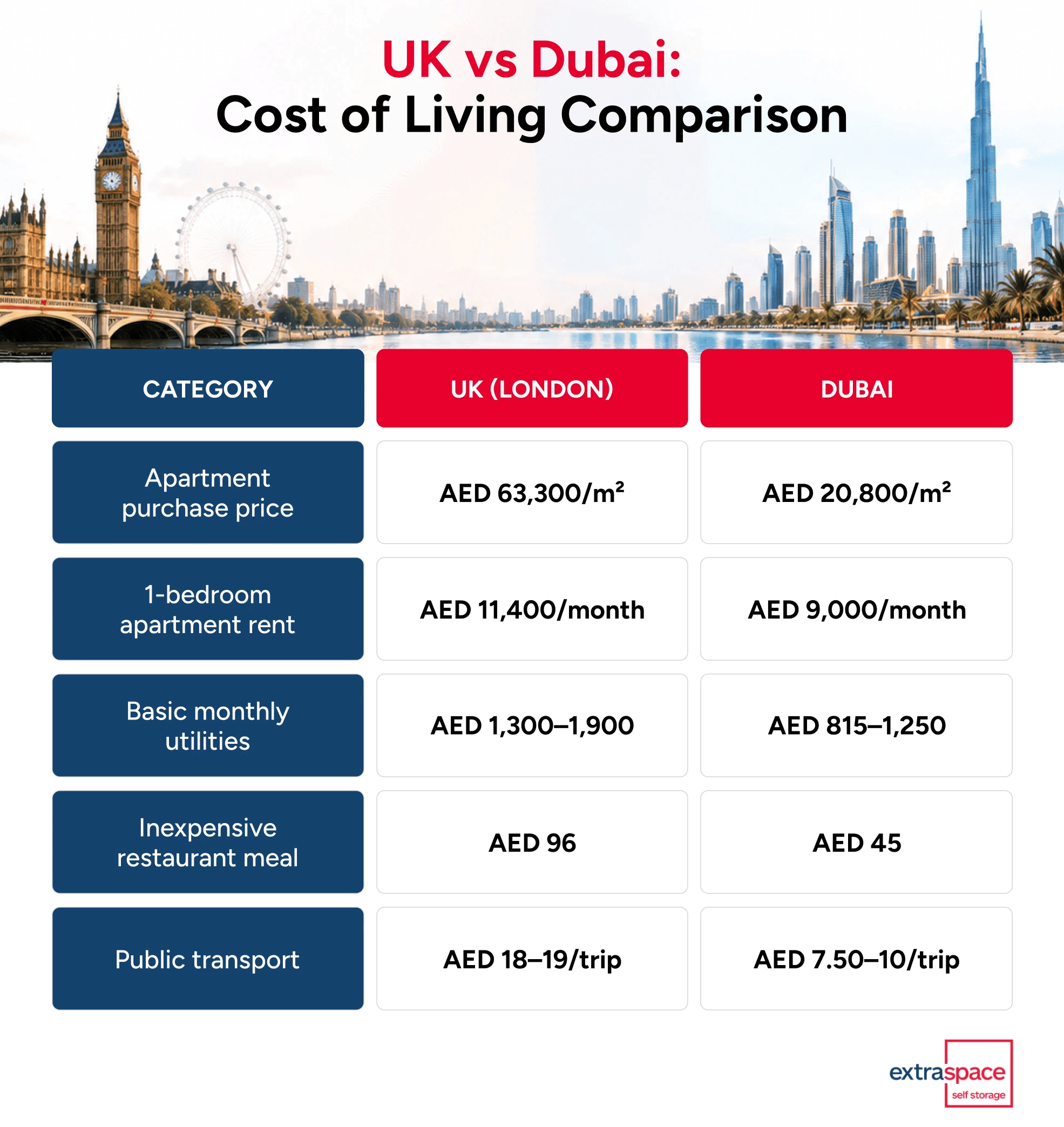
The UAE has no federal personal income tax, while VAT applies to taxable supplies at 5%. However, housing, transport, utilities and schooling still need to be factored into your budget, so compare these with your current UK outgoings rather than looking at salary differences alone.
Budget for Your Relocation Separately
Don't compare monthly salary with regular expenses alone. Set aside a separate lump sum for upfront payments such as rent, deposits, utility setup, flights and shipping, which may fall due before your normal monthly spending begins.
Find Work and Understand Employment Requirements
If you're moving for a job, understand your sponsorship arrangement, responsibilities and associated expenses. Those working independently can explore other residence options.
Work Situation | What to Know |
UAE Employment | Your employer typically initiates the residence application and generally covers specified recruitment, entry-visa and post-arrival expenses, including medical examinations and residence-permit issuance. |
Remote Work | You can live in Dubai while continuing with a UK or overseas employer, subject to the applicable income and eligibility conditions. |
Freelance or Self-Employment | Green Residence and other independent-work options may suit eligible professionals and freelancers who meet the relevant criteria. |
Before accepting a position, clarify what your employer will handle and which expenses or formalities fall to you.
Find Somewhere to Live in Dubai
When choosing a home, look beyond the advertised rent or purchase price and consider the arrangement, location and setup involved.
Should You Rent or Buy?
Renting can be a practical starting point when you first arrive, giving you flexibility while you get to know different areas. Expats can buy in designated areas, subject to applicable rules, but renting may suit those who want time to decide where to settle. Either way, consider the total upfront amount rather than the monthly rent or purchase price alone.
Dubai's Rental Payment Structure
Rental agreements may require payment in one or more instalments, commonly through post-dated cheques. The number of payments is agreed with the landlord and set out in the tenancy agreement rather than fixed by law.
Choose a Location Based on Your Needs
Consider your workplace and commute, nearby schools where relevant, public transport, parking, budget and everyday amenities. If an area is highly car-dependent, factor that into your transport needs as well. Rank your priorities before viewing properties so you can compare locations more consistently.
Understand Ejari Registration
An Ejari-registered tenancy contract formalises your rental agreement and is commonly used for utilities and certain residency-related administrative processes. Not every procedure requires it, so check what applies to your situation.

Understand Healthcare Requirements in Dubai
Before you arrive, make sure you understand the cover available to you and how to handle medicines and health records during the journey.
Check Your Health Insurance Requirements
Dubai's healthcare system differs from the NHS, and health insurance is generally required for residency. If you're sponsored by an employer, check what cover is provided and whether it extends to dependants, as family policies may be arranged separately.
When comparing a policy, check whether it covers:
Outpatient treatment
Maternity care
Pre-existing conditions
A basic plan may not provide the same level of cover you're used to, so factor any additional cover into your budget.
Prepare Your Medical Records
Keep relevant prescriptions and medical records with you rather than packing them with household goods. If you take regular medication, check its status in the UAE before travelling; something available without restriction in the UK may be controlled there.
Check Medication Before You Travel
For narcotic or controlled medicines, check current MOHAP rules before departure. Travellers can apply for electronic approval in advance; if you have not obtained approval, the medicine should be declared on arrival with the prescription and medical report. Quantities are generally limited to a maximum three-month supply.
A medicine's classification depends on its active ingredient and the UAE's control schedule, so check each one individually rather than assuming it is permitted.
Moving to Dubai With Children
Plan the main arrangements around your children's schooling, paperwork and arrival.
Area | What to Consider |
Schools | Dubai offers British-curriculum, American, IB and other international options, with significant differences in fees. Admissions may require previous school reports or an assessment, and popular schools can have limited places. Check term dates and admissions deadlines early, particularly if you're considering a mid-year start. |
Family Paperwork | Keep passports, birth and marriage certificates where relevant, school records and medical records accessible. Legalise or attest any certificates that the relevant authority requires. |
Arrival Planning | Coordinate your accommodation, school start date, healthcare, essential belongings and transport so the main arrangements are ready around your arrival. |
Bringing Your Belongings From the UK to Dubai
Before arranging transport, decide what you're bringing, how it will travel and what you'll need to clear customs on arrival.
Choose How to Transport Your Belongings
Air freight, groupage in a shared container and a sole-use container are options for international shipping, depending on volume, timeline and budget. Smaller consignments with flexible deadlines may suit groupage, while a full household with tighter timing may justify a dedicated container.
Understand Dubai Customs Rules for Household Goods
First-time residents may qualify for a customs-duty exemption on used personal effects and household goods if the items are genuinely used, appropriate for furnishing a home and imported in the resident's own name. Dubai Customs' guidance, updated 2 September 2026, also requires proof of work or residence and a full packing list.
New purchases are treated differently. Goods imported in commercial quantities can attract 5% customs duty following inspection, which is particularly relevant if you're bringing recently purchased furniture or electronics alongside older possessions.

Check Prohibited and Restricted Items
Dubai Customs lists prohibited and restricted categories including narcotic drugs, poppy seeds, gambling equipment, used or reconditioned tyres, certain media and materials, pharmaceutical products, food, plants and animals, radio or transmitter equipment, firearms and ammunition, e-cigarettes and alcohol.
The list is not exhaustive, so verify any item you're unsure about before packing it. Cannabis-derived products, including CBD, should not be assumed to be permitted simply because they are legal in the UK.
Prepare Your Shipping Documents
For household imports, Dubai Customs asks for your passport or Emirates ID, residency visa where applicable and a written list of the goods you're bringing, alongside relevant freight paperwork. Restricted items may also require supporting permits.
What About Your Car
A vehicle has separate import rules from household goods. Dubai Customs currently applies 5% customs duty on the assessed value of new and used vehicles. The paperwork differs depending on whether the import is handled by a shipping company or an individual, so check the applicable procedure if you plan to bring your car.
Open a Bank Account and Manage Your Finances
Residency and an Emirates ID commonly form part of the paperwork banks ask for, although criteria vary by provider and account type. You may also need your passport, visa, salary certificate or employment letter, bank statements and proof of address. Check with your chosen bank for its current criteria before applying.
Before leaving the UK, check whether your bank allows you to keep your existing account while living abroad. Review any standing orders and direct debits that will continue after your departure, and make arrangements for managing them from overseas.
What Other Requirements Should You Consider?
A few additional considerations may apply depending on your circumstances:
Area | What to Know |
Bringing Pets | Cats and dogs require prior import permission, permanent microchipping and supporting veterinary and vaccination paperwork. Rules vary by country of origin, so check the current requirements for UK-origin pets, including whether a rabies antibody test applies. |
Driving | The UK is currently on the RTA's eligible-country list for licence exchange. A valid UK licence may therefore be exchanged without the standard test route, subject to RTA requirements, including a valid Emirates ID, approved eye test and original licence. |
Retiring | Retirement residence options are available to qualifying applicants based on criteria such as income, savings or property. If you're receiving a UK pension, check how payment, tax and reporting obligations may change after leaving the UK. |
Moving to Dubai From the UK: Your 2026 Checklist
Before Leaving the UK
Confirm your UAE residence route
Check passport validity
Review HMRC and P85 considerations
Prepare important documents
Check whether documents need legalisation or attestation
Arrange healthcare and insurance
Research housing and schools if applicable
Build an initial relocation budget
Decide what to take, sell, donate or store
Before Shipping
Check prohibited and restricted goods
Prepare an itemised packing list
Gather customs paperwork
Choose air freight, groupage or a sole-use container
Separate essential items
Check medication requirements
Check vehicle requirements if importing a car
Arrange storage if your departure and delivery dates don't align
After Arriving
Complete residence requirements
Complete Emirates ID procedures
Finalise housing
Register your tenancy where applicable
Set up utilities
Arrange banking
Confirm healthcare
Complete customs clearance
Receive your household goods
Moving to Dubai From the UK With Confidence
Moving to Dubai from the UK involves several practical steps, but having the right information in the right order can make the process easier to manage. Use this guide as a starting point, and confirm current rules with the relevant authorities as your plans progress.

